Course 3: The 30% Rule Nobody Told You About
Course 3
The 30% Rule Nobody Told You About
You pay your credit cards on time every month. So why is your score still not where you want it? The answer might be a number most people have never heard of: your utilization ratio.
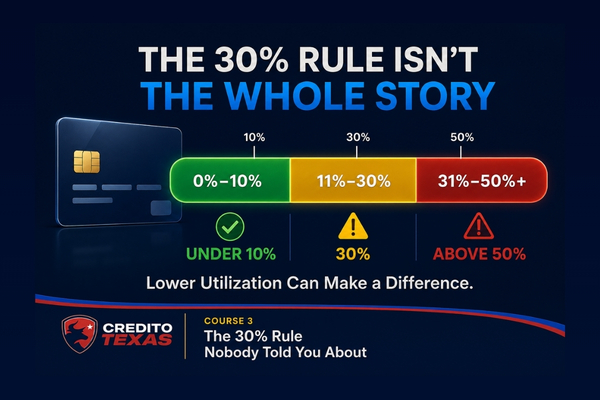
Credit utilization is the percentage of your available credit that you're currently using. It accounts for 30% of your credit score — making it the second most important factor after payment history. Yet it's one of the most misunderstood aspects of credit.
Here's how it works: if you have a credit card with a $5,000 limit and you're carrying a $3,500 balance, your utilization on that card is 70%. Even if you pay your minimum every month and never miss a payment, that high utilization is silently dragging your score down.
The general guideline is to keep your utilization below 30% across all of your credit cards. So if your total credit limit is $10,000, try to keep your total balances below $3,000. For the best possible score impact, aim for under 10%.
There are several strategies to improve your utilization: Pay down balances as aggressively as possible, starting with the cards closest to their limit. Ask for a credit limit increase — if you're approved, your utilization automatically decreases even if your balance stays the same. Spread balances across multiple cards rather than maxing out one. Pay more than once a month, since the balance reported to the bureaus is often your statement balance, not what you pay by the due date.
One important nuance: utilization is calculated both per-card and across all of your cards combined. Even if your overall utilization is low, one maxed-out card can still hurt you.
This is one of the fastest ways to see score movement. Because utilization is reported monthly, improvements in this area can show up in your score within 30 to 60 days.
